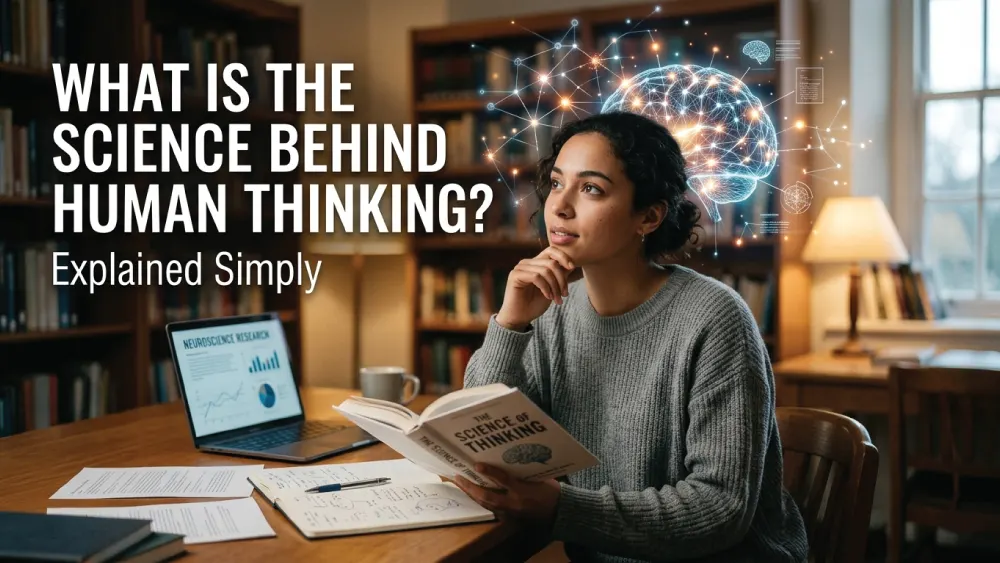
Have you ever wondered how your mind works when you solve a problem, make a decision, or imagine something new? The science behind human thinking is both fascinating and complex. It combines insights from neuroscience, psychology, and even philosophy to explain how our brains process information.
In this ever-evolving informational blog by Info Verse 360, we simplify the science behind thinking so anyone can understand it-no scientific background required.
What Is Human Thinking?
Human thinking is the mental process of acquiring knowledge, understanding information, solving problems, and making decisions. It involves a wide range of activities such as reasoning, imagining, remembering, and judging.
From a scientific perspective, thinking is the result of electrical and chemical activity in the brain. These processes allow us to interpret the world, learn from experiences, and adapt to new situations.
The Brain: Control Center of Thought
The brain is the most important organ responsible for thinking. It contains billions of nerve cells that work together to process information.
Key areas involved in thinking include:
- Prefrontal Cortex – Responsible for decision-making and problem-solving
- Hippocampus – Plays a major role in memory formation
- Amygdala – Handles emotions and emotional responses
All these parts work together to create what we experience as “thinking.”
How Neurons Communicate
At the core of thinking lies the communication between neurons. Neurons are specialized cells that transmit information through electrical and chemical signals.
This process is explained by the Synaptic Transmission.
Here’s how it works:
- A neuron sends an electrical signal
- The signal reaches the synapse (gap between neurons)
- Chemicals called neurotransmitters carry the signal to the next neuron
- The process repeats across networks
This rapid communication allows us to think, react, and respond almost instantly.
Types of Thinking Explained
Human thinking is not just one process-it comes in different forms depending on the situation.
Logical Thinking
Used for reasoning and problem-solving. For example, solving a math equation.
Creative Thinking
Involves imagination and innovation, like designing or storytelling.
Critical Thinking
Analyzing information objectively before making decisions.
Abstract Thinking
Understanding concepts that are not physically present, such as time or justice.
Each type of thinking activates different areas of the brain and involves unique neural pathways.
The Role of Memory in Thinking
Thinking and memory are deeply connected. Without memory, thinking would not be possible.
Memory works through a process called Memory Consolidation, where information is stored and strengthened over time.
There are three main types of memory:
- Short-term memory – Holds information temporarily
- Long-term memory – Stores information for extended periods
- Working memory – Used during active thinking tasks
For example, when solving a problem, your brain uses working memory while accessing long-term memory for past knowledge.
Emotions and Their Influence on Thought
Thinking is not purely logical-emotions play a huge role.
The Limbic System influences how we think and make decisions. For instance:
- Fear can lead to quick decisions
- Happiness can enhance creativity
- Stress can impair logical thinking
This is why sometimes we make decisions based on feelings rather than facts.
Conscious vs. Subconscious Thinking
Our thinking operates on two levels:
Conscious Thinking
- Active and deliberate
- Used for decision-making and reasoning
Subconscious Thinking
- Automatic and fast
- Handles habits and instincts
This concept is closely related to Dual Process Theory, which explains how our brain uses both fast and slow thinking systems.
Cognitive Biases and Mental Shortcuts
The brain often uses shortcuts to save time and energy. These are called cognitive biases.
Some common examples include:
- Confirmation Bias – Favoring information that supports beliefs
- Anchoring Bias – Relying heavily on the first piece of information
- Availability Heuristic – Judging based on recent or memorable events
These biases can sometimes lead to errors in thinking, but they also help us make quick decisions in daily life.
Can Thinking Be Improved?
Yes, thinking can be improved with practice and awareness.
Here are some proven ways:
- Read regularly to expand knowledge
- Practice problem-solving exercises
- Meditate to improve focus
- Learn new skills to challenge your brain
- Question assumptions to avoid bias
Neuroscience shows that the brain has the ability to change and adapt, a concept known as Neuroplasticity.
The Ever-Evolving Nature of Human Thinking
One of the most fascinating aspects of human thinking is that it is constantly evolving.
As technology advances and new discoveries are made, our understanding of thinking continues to grow. Fields like artificial intelligence and cognitive neuroscience are pushing the boundaries of what we know about the mind.
Platforms like Info Verse 360 aim to keep readers updated with such ever-evolving insights, making complex topics easy to understand and apply in everyday life.
Conclusion
The science behind human thinking is a blend of biology, psychology, and experience. From neurons firing in the brain to emotions shaping decisions, thinking is a dynamic and complex process.
Understanding how we think can help us improve our decision-making, enhance creativity, and become more aware of our mental patterns. As research continues to evolve, we will uncover even deeper insights into the human mind.
FAQs
What is the main function of thinking?
Thinking helps us process information, solve problems, make decisions, and understand the world around us.
Which part of the brain controls thinking?
The prefrontal cortex is mainly responsible for higher-level thinking, including reasoning and decision-making.
Can thinking patterns change over time?
Yes, due to neuroplasticity, the brain can adapt and form new thinking patterns.
How do emotions affect thinking?
Emotions influence decision-making, memory, and focus, sometimes enhancing or impairing thinking.
What are cognitive biases?
Cognitive biases are mental shortcuts that help in quick decision-making but can sometimes lead to errors.
How can I improve my thinking skills?
You can improve thinking by reading, learning new skills, practicing mindfulness, and challenging your assumptions.